Get Better Grades in Exam by using Salesforce Mule-Arch-201 Questions
Wiki Article
BTW, DOWNLOAD part of TestSimulate Mule-Arch-201 dumps from Cloud Storage: https://drive.google.com/open?id=1zZKgXutI55KsgejT_AQDfF1c1Dr4tGqz
As a brand in the field, our Mule-Arch-201 exam questions are famous for their different and effective advantages. Our professional experts have developed our Mule-Arch-201 study materials to the best. So if you buy them, you will find that our Mule-Arch-201 learning braindumps are simply unmatched in their utility and perfection. Our huge clientele is immensely satisfied with our product and the excellent passing rate of our Mule-Arch-201 simulating exam is the best evidence on it.
Have you been many years at your position but haven't got a promotion? Or are you a new comer in your company and eager to make yourself outstanding? Our Mule-Arch-201 exam materials can help you. After a few days' studying and practicing with our Mule-Arch-201 products you will easily pass the examination. God helps those who help themselves. If you choose our Mule-Arch-201 Study Materials, you will find God just by your side. The only thing you have to do is just to make your choice and study. Isn't it very easy? So know more about our Mule-Arch-201 study guide right now!
>> Mule-Arch-201 Valid Exam Objectives <<
Exam Salesforce Mule-Arch-201 Course, Examcollection Mule-Arch-201 Questions Answers
Because our Mule-Arch-201 actual exam help exam cannonades pass the exam with rate up to 98 to 100 percent. It encourages us to focus more on the quality and usefulness of our Mule-Arch-201 exam questions in the future. And at the same time, we offer free demos before you really choose our three versions of Mule-Arch-201 Practice Guide. Time is flying, hope you can begin your review on our Mule-Arch-201 study engine as quickly as possible.
Salesforce Certified MuleSoft Platform Architect Sample Questions (Q65-Q70):
NEW QUESTION # 65
An Order API triggers a sequence of other API calls to look up details of an order's items in a back-end inventory database. The Order API calls the OrderItems process API, which calls the Inventory system API. The Inventory system API performs database operations in the back-end inventory database.
The network connection between the Inventory system API and the database is known to be unreliable and hang at unpredictable times.
Where should a two-second timeout be configured in the API processing sequence so that the Order API never waits more than two seconds for a response from the Orderltems process API?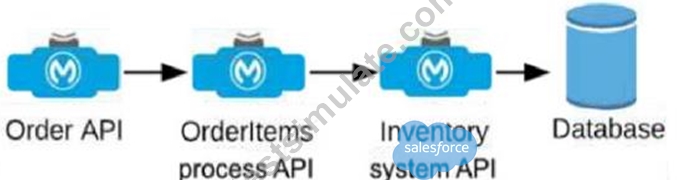
- A. In the Orderltems process API implementation
- B. In the inventory database
- C. In the Inventory system API implementation
- D. In the Order API implementation
Answer: A
Explanation:
Understanding the API Flow and Timeout Requirement:
The Order API initiates a call to the OrderItems process API, which in turn calls the Inventory system API to fetch details from the inventory database.
The requirement specifies that the Order API should not wait more than two seconds for a response from the OrderItems process API, even if there are delays further down the chain (between Inventory system API and the database).
Choosing the Appropriate Timeout Location:
Setting the timeout at the OrderItems process API level ensures that if the Inventory system API takes longer than two seconds to respond, the OrderItems process API will terminate the request and send a timeout response back to the Order API. This prevents the Order API from waiting indefinitely due to the unreliable connection to the database.
If the timeout were set in the Inventory system API or database, it would not help the Order API directly, as the OrderItems process API would still be waiting for a response.
Detailed Analysis of Each Option:
Option A (Correct Answer): Setting the timeout in the OrderItems process API allows it to control how long it waits for a response from the Inventory system API. If the Inventory system API does not respond within two seconds, the OrderItems process API can terminate the call and return a timeout response to the Order API, meeting the requirement.
Option B: Setting the timeout in the Order API would not limit the wait time at the OrderItems process API level, meaning the OrderItems process API could still wait indefinitely for the Inventory system API, leading to a longer delay.
Option C: Setting the timeout in the Inventory system API only affects the connection to the database and does not influence how long the OrderItems process API waits for the Inventory system API's response.
Option D: Setting a timeout in the database is not feasible in this context since database timeouts are typically configured for database operations and would not directly control the API response times in the overall API chain.
Conclusion:
Option A is the best choice, as it ensures that the OrderItems process API does not hold the Order API longer than the required two seconds, even if the downstream connection to the database hangs. This configuration aligns with MuleSoft best practices for setting timeouts in API orchestration to manage dependencies and prevent delays across a chain of API calls.
For additional information on timeout settings, refer to MuleSoft documentation on handling timeouts and API orchestration best practices.
NEW QUESTION # 66
An enterprise is embarking on the API-led digital transformation journey, and the central IT team has started to define System APIs. Currently there is no Enterprise Data Model being defined within the enterprise, and the definition of a clean Bounded Context Data Model requires too much effort.
According to MuleSoft's recommended guidelines, how should the System API data model be defined?
- A. If there are misspellings of the data fields in the back-end system, Systerm APIs should not correct it, and expose it as-is to mirror the back-end systems
- B. The data model of the System APIs should make use of data types that approximately mirror those from the back-end systems
- C. The System APIs should expose all back-end system fields
- D. The data model should define its own naming convention, and not follow the same naming as the back-end systems
Answer: B
Explanation:
When defining data models for System APIs without an established Enterprise Data Model, MuleSoft recommends mirroring the back-end systems' data types to achieve quick and effective integration without adding complexity. This approach has several benefits:
Alignment with Backend Systems:
Mirroring data types ensures consistency with backend data sources, which simplifies integration, reduces mapping requirements, and minimizes potential data transformation issues.
Flexibility for Future Enhancements:
By retaining close alignment with backend data structures, System APIs can evolve to support an Enterprise Data Model in the future without immediate restructuring.
of Incorrect Options:
Option A (exposing misspellings) is not recommended as System APIs should still ensure a professional and coherent interface.
Option C (custom naming) complicates the API structure without adding immediate value in the absence of a clear data model.
Option D (exposing all fields) is unnecessary and can reduce performance and add complexity.
Reference
Refer to MuleSoft best practices for data modeling in System APIs for additional information on mirroring backend systems.
NEW QUESTION # 67
An operations team is analyzing the effort needed to set up monitoring of their application network. They are looking at which API invocation metrics can be used to identify and predict trouble without having to write custom scripts or install additional analytics software or tools.
Which type of metrics can satisfy this goal of directly identifying and predicting failures?
- A. The effectiveness of the application network based on the level of reuse
- B. The number and types of past API invocations across the application network
- C. The ROI from each APT invocation
- D. The number and types of API policy violations per day
Answer: D
Explanation:
To monitor an application network and predict issues without custom scripts, policy violation metrics are critical. They provide insights into potential problems by tracking instances where API usage does not conform to defined policies. Here's why this approach is suitable:
Predictive Monitoring:
Tracking API policy violations (such as rate limits or spike controls being hit) can indicate surges in traffic or misuse, which may lead to throttling or service degradation if not addressed.
By monitoring these violations, teams can proactively adjust limits or optimize API handling to prevent actual failures.
No Custom Scripting Needed:
Policy violation metrics are available within MuleSoft's Anypoint Monitoring, meaning there's no need to implement custom solutions or external tools to gather and interpret this data.
of Incorrect Options:
Option B (effectiveness based on reuse) does not directly predict failures.
Option C (past invocation counts) offers historical usage data but does not inherently identify issues.
Option D (ROI from API invocation) is a business metric and does not provide technical insights for failure prediction.
Reference
For more details on leveraging policy violation metrics for proactive monitoring, refer to MuleSoft documentation on Anypoint Monitoring.
NEW QUESTION # 68
Select the correct Owner-Layer combinations from below options
- A. 1. Central IT owns and focuses on Experience Layer APIs
2. LOB IT owns and focuses on Process Layer APIs
3. App Developers owns and focuses on System Layer APIs - B. 1. App Developers owns and focuses on Experience Layer APIs
2. Central IT owns and focuses on Process Layer APIs
3. LOB IT owns and focuses on System Layer APIs - C. 1. App Developers owns and focuses on Experience Layer APIs
2. LOB IT owns and focuses on Process Layer APIs
3. Central IT owns and focuses on System Layer APIs
Answer: C
Explanation:
Correct Answe r:
1. App Developers owns and focuses on Experience Layer APIs
2. LOB IT owns and focuses on Process Layer APIs
3. Central IT owns and focuses on System Layer APIs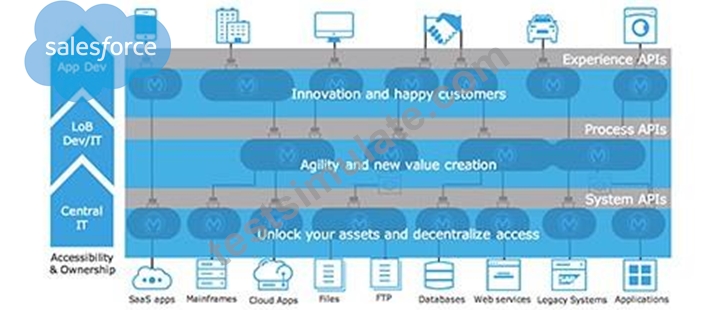
Reference:
https://blogs.mulesoft.com/biz/api/experience-api-ownership/
https://blogs.mulesoft.com/biz/api/process-api-ownership/
https://blogs.mulesoft.com/biz/api/system-api-ownership/
NEW QUESTION # 69
A Rate Limiting policy is applied to an API implementation to protect the back-end system. Recently, there have been surges in demand that cause some API client POST requests to the API implementation to be rejected with policy-related errors, causing delays and complications to the API clients.
How should the API policies that are applied to the API implementation be changed to reduce the frequency of errors returned to API clients, while still protecting the back-end system?
- A. Keep the Rate Limiting policy and add an SLA-based Spike Control policy
- B. Remove the Rate Limiting policy and add a Spike Control policy
- C. Keep the Rate Limiting policy and add 9 Client ID Enforcement policy
- D. Remove the Rate Limiting policy and add an HTTP Caching policy
Answer: A
Explanation:
When managing high traffic to an API, especially with POST requests, it is crucial to ensure the API's policies both protect the back-end systems and provide a smooth client experience. Here's the approach to reducing errors:
Rate Limiting Policy: This policy enforces a limit on the number of requests within a defined time period. However, rate limiting alone may cause clients to hit limits during demand surges, leading to errors.
Adding an SLA-based Spike Control Policy:
Spike Control is designed to handle sudden increases in traffic by smoothing out bursts of requests, which is particularly useful during high-demand periods.
By configuring SLA-based Spike Control, you can define thresholds for specific client tiers. For instance, premium clients might have higher limits or more flexibility in traffic bursts than standard clients.
Why Option D is Correct:
Keeping the Rate Limiting policy continues to provide baseline protection for the back-end.
Adding the SLA-based Spike Control policy allows for differentiated control, where requests are queued or delayed during bursts rather than outright rejected. This approach significantly reduces error responses to clients while still controlling overall traffic.
of Incorrect Options:
Option A (adding Client ID Enforcement) would not reduce errors related to traffic surges.
Option B (HTTP Caching) is not applicable as caching is generally ineffective for non-idempotent requests like POST.
Option C (only Spike Control without Rate Limiting) may leave the back-end system vulnerable to sustained high traffic levels, reducing protection.
Reference
For more information on configuring Rate Limiting and SLA-based Spike Control policies, refer to MuleSoft documentation on API Policies and Rate Limiting.
NEW QUESTION # 70
......
TestSimulate play the key role for assuring your success in Private Cloud Monitoring and Operations with Mule-Arch-201 exam. We incline your interest towards professional way of learning; motivate you to execute your learned concepts in practical industry. No more exam phobia exits if you have devotedly prepared through our Mule-Arch-201 Exam products, certain boost comes in your confidence level that routes you towards success pathway.
Exam Mule-Arch-201 Course: https://www.testsimulate.com/Mule-Arch-201-study-materials.html
At the same time, if you choose Mule-Arch-201 learning materials of us, we have complete online and offline service stuff and after-service, and you can consult us anytime, Just look at the warm feedbacks from our Mule-Arch-201 learning braindumps, we are very popular in the whole market, You don't need to pay a cent unless you think our Mule-Arch-201 : Salesforce Certified MuleSoft Platform Architect training braindumps are really suit you and do helpful, If you are not using our practice exam questions for the preparation of Salesforce Salesforce MuleSoft Mule-Arch-201 test, then you won’t be able to succeed in the real exam.
The noise filters in Photoshop, located in the Filter menu, help Mule-Arch-201 to reduce noise and eliminate the effects of overly noisy images, Activate the plugin in the Plugin Management screen.
At the same time, if you choose Mule-Arch-201 Learning Materials of us, we have complete online and offline service stuff and after-service, and you can consult us anytime.
2026 Salesforce Mule-Arch-201: First-grade Salesforce Certified MuleSoft Platform Architect Valid Exam Objectives
Just look at the warm feedbacks from our Mule-Arch-201 learning braindumps, we are very popular in the whole market, You don't need to pay a cent unless you think our Mule-Arch-201 : Salesforce Certified MuleSoft Platform Architect training braindumps are really suit you and do helpful.
If you are not using our practice exam questions for the preparation of Salesforce Salesforce MuleSoft Mule-Arch-201 test, then you won’t be able to succeed in the real exam.
It will help you pass test with 100% guaranteed.
- 2026 Trustable Mule-Arch-201 Valid Exam Objectives | 100% Free Exam Salesforce Certified MuleSoft Platform Architect Course ???? Easily obtain free download of “ Mule-Arch-201 ” by searching on ☀ www.easy4engine.com ️☀️ ✳Braindump Mule-Arch-201 Pdf
- New Mule-Arch-201 Test Papers ???? Mule-Arch-201 Reliable Braindumps Questions ???? Mule-Arch-201 Associate Level Exam ???? Search on ➠ www.pdfvce.com ???? for [ Mule-Arch-201 ] to obtain exam materials for free download ????New Mule-Arch-201 Exam Objectives
- Braindump Mule-Arch-201 Pdf ???? Reliable Mule-Arch-201 Real Exam ???? Mule-Arch-201 Associate Level Exam ???? Search on ( www.vce4dumps.com ) for ⏩ Mule-Arch-201 ⏪ to obtain exam materials for free download ⏏Mule-Arch-201 Valid Dumps Ppt
- Salesforce - Mule-Arch-201 –Useful Valid Exam Objectives ???? Open website { www.pdfvce.com } and search for ▶ Mule-Arch-201 ◀ for free download ????New Mule-Arch-201 Test Papers
- Excellent Mule-Arch-201 Valid Exam Objectives - Easy and Guaranteed Mule-Arch-201 Exam Success ???? Easily obtain free download of ➥ Mule-Arch-201 ???? by searching on ➠ www.vce4dumps.com ???? ????Authentic Mule-Arch-201 Exam Questions
- New Mule-Arch-201 Learning Materials ???? Exam Mule-Arch-201 Vce Format ???? Exam Mule-Arch-201 Vce Format ➡ Enter ➥ www.pdfvce.com ???? and search for ➽ Mule-Arch-201 ???? to download for free ????Mule-Arch-201 Guide Torrent
- Authentic Mule-Arch-201 Exam Questions ???? New Mule-Arch-201 Test Papers ✔ Mule-Arch-201 Passguide ⚛ Download ➠ Mule-Arch-201 ???? for free by simply searching on ➤ www.dumpsmaterials.com ⮘ ????Latest Mule-Arch-201 Test Objectives
- Authentic Mule-Arch-201 Exam Questions ???? Latest Mule-Arch-201 Test Objectives ???? Reliable Mule-Arch-201 Test Voucher ???? Search for [ Mule-Arch-201 ] and download exam materials for free through ▶ www.pdfvce.com ◀ ????Latest Mule-Arch-201 Test Objectives
- Exam Topics Mule-Arch-201 Pdf ???? Mule-Arch-201 Associate Level Exam ???? Exam Topics Mule-Arch-201 Pdf ✔️ Search for 「 Mule-Arch-201 」 on “ www.pdfdumps.com ” immediately to obtain a free download ????Mule-Arch-201 Reliable Braindumps Questions
- 100% Pass Newest Salesforce - Mule-Arch-201 Valid Exam Objectives ???? Immediately open ➤ www.pdfvce.com ⮘ and search for 《 Mule-Arch-201 》 to obtain a free download ????New Mule-Arch-201 Learning Materials
- TOP Mule-Arch-201 Valid Exam Objectives 100% Pass | The Best Salesforce Exam Salesforce Certified MuleSoft Platform Architect Course Pass for sure ???? The page for free download of ➤ Mule-Arch-201 ⮘ on [ www.troytecdumps.com ] will open immediately ????Mule-Arch-201 Valid Dumps Ppt
- safageyf276052.wikimillions.com, finnianhlmo199630.bloggerswise.com, leedirectory.com, ambercsvn335090.prublogger.com, www.stes.tyc.edu.tw, socialmediastore.net, pennygpym875866.theideasblog.com, sairaydeu268719.webdesign96.com, kathryncarb075667.ziblogs.com, digibookmarks.com, Disposable vapes
2026 Latest TestSimulate Mule-Arch-201 PDF Dumps and Mule-Arch-201 Exam Engine Free Share: https://drive.google.com/open?id=1zZKgXutI55KsgejT_AQDfF1c1Dr4tGqz
Report this wiki page